
Put Something on It: How Small Extra Payments Can Help You Pay Down Debt
What if making progress on what you owe didn’t require finding hundreds of extra dollars every month? Bills don’t stop coming. Groceries still need to be purchased. Gas tanks still need filling. And sometimes, after taking care of everything else, there’s not much left to put toward your financial goals. But here’s something worth considering: What if you could put just a little more toward what you owe, consistently? That’s the idea behind Everyday Micropayments. Small amounts, chosen by you, can add up over time. Let’s look at how that works.
Why Paying Only the Minimum Can Keep You Owing Longer
Your monthly payment does two things: it helps cover interest and reduces what you owe. When you’re carrying a credit card balance, part of each payment generally goes toward interest. That means not every dollar you pay reduces the original amount you borrowed. The higher your interest rate, the harder it can feel to make progress. Paying more than your minimum, when your budget allows, can help reduce your balance faster and lower your total interest costs. The extra amount doesn’t have to be huge to matter.
Let’s Do the Math: $1,000 at 24% Interest
Imagine you have a credit card with a $1,000 balance and a 24% annual percentage rate (APR).
For this example, we’ll assume you make a fixed $30 payment every month, don’t add new charges, and don’t incur any fees.
After 12 months, here’s what could happen:
| Comparison | Regular | With Extra |
|---|---|---|
| Starting balance | $1,000 | $1,000 |
| Monthly payment | $30 | $70 |
| Extra monthly amount | $0 | $40 |
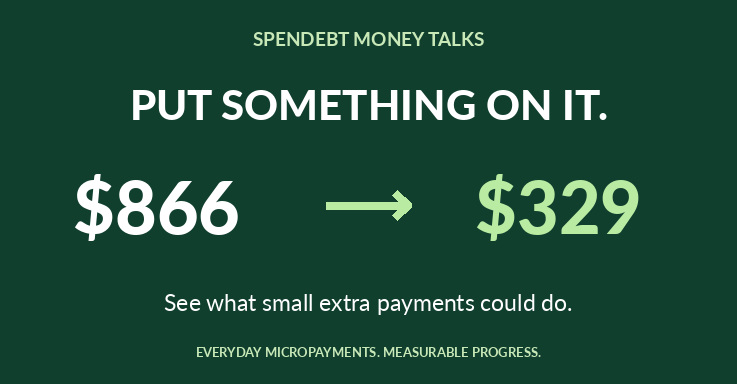
| Balance after 12 months | $866 | $329 |
| Interest paid | $225.88 | $169.40 |
Here’s where the additional money comes from. That’s over $536 less owed after one year! Suppose you choose to put an extra $1 toward your balance for each of 40 eligible everyday transactions in a month. $1 × 40 transactions = $40 extra per month. Add that $40 to your regular $30 payment, and you’re contributing $70 monthly instead of $30.
Across 12 months, that means you’ve contributed an additional $480 toward what you owe. Under our simplified example, you also avoid about $56 in interest. That’s the difference. Not a financial windfall. Not free money. Just additional payments you chose to make, working alongside your regular payment.
These figures use a simplified monthly interest calculation: 24% APR divided by 12, with payments applied at the end of each month. Actual credit card interest is often calculated daily. Required minimum payments can change, and results depend on payment timing, rates, fees, and new charges. The example excludes SpenDebt’s subscription fee.
What Could Your Own Small Payments Add Up To?
You don’t have to start with $1. The right amount is one that fits your finances.
Here are a few hypothetical examples using 40 eligible transactions in a month:
| Extra per transaction | Additional monthly amount |
|---|---|
| $0.50 | $20 |
| $1.00 | $40 |
| $2.00 | $80 |
These are examples, not an estimate of how often a typical SpenDebt customer transacts. Your actual amount depends on the transactions you make and any limits you set. The point isn’t to spend more money to trigger extra payments. It’s to use the everyday spending you’re already doing as an opportunity to make additional progress.
And if you’re working with a tighter budget, start small. You can always revisit the amount when your finances change.
How SpenDebt Helps You Put Something Extra on It
SpenDebt was built around a simple belief: financial progress shouldn’t require perfection. With SpenDebt’s Everyday Micropayments, you choose a fixed amount associated with eligible transactions, starting at $0.50. You connect your bank account, select the eligible account you want to pay down, and set an amount that works for you. As eligible transactions occur, your micropayments accumulate. SpenDebt then sends the accumulated funds toward your selected account according to its payment schedule. Unlike traditional round-up tools, your chosen micropayment doesn’t depend on how close a purchase is to the next whole dollar. You decide the amount. You stay in control. SpenDebt also allows you to adjust your micropayment and monthly cap, so you can make choices that reflect your budget. These payments are intended to complement your existing payment obligations, not replace required minimum payments.
Three Ways to Start Making Extra Progress
1. Know what you’re paying. Look at your current balance, interest rate, and monthly payment. Understanding how much goes toward interest can help you decide where additional payments may be most useful. 2. Choose an affordable extra amount. Whether it’s $0.50, $1, or a different manageable amount, make sure it fits alongside essentials, required bills, and your financial cushion. 3. Build consistency—not pressure. Financial progress isn’t about having a perfect month. It’s about choosing a sustainable approach and sticking with it as your circumstances allow.
Small Payments. Measurable Progress.
The goal isn’t to make your financial life more complicated.
It’s to make progress feel possible. A $1 micropayment may not seem like much on its own. But when small contributions add up and go toward what you owe, they can become part of a meaningful repayment strategy. You don’t have to wait until you have a large amount of extra money. Put something on it.
Ready to see how Everyday Micropayments work? Discover SpenDebt and explore a payment amount that fits your life.
Everyday Micropayments. Measurable Progress.
A Note About the Example
This article is educational and does not provide individualized financial advice or guarantee repayment results. The example assumes a $1,000 beginning balance, a constant 24% APR modeled as 2% monthly interest, fixed end-of-month payments of either $30 or $70, and no additional purchases or fees. The hypothetical 40 transactions per month are not SpenDebt customer data. Real credit cards commonly use daily interest calculations; payment posting times and terms affect actual results. SpenDebt currently offers a free trial followed by a $3.99 monthly subscription, which is not included in the repayment example. For further information, see the Consumer Financial Protection Bureau’s explanation of credit card interest and its guidance on repayment amounts.